
Inside The Stock Market ...trends, cross-currents, and outlook
Stuck In Neutral?
Extreme market viewpoints get the headlines, but it’s baked into our disciplines that we will (occasionally) be noncommittal.
Stock Market Observations
Market gains have been less broad than in 2012 and 2013; market direction and leadership have been mismatched; and quantitative factors have been choppy.
Broadly Expensive — Downside To Past Market Highs (And Lows)
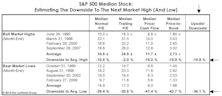
The median S&P 500 stock is now expensive enough that we’re able to estimate its potential downside to prior bull market highs! Based on an average of four valuation measures, the median stock needs to drop about –11% to match the typical valuations at the eve of a cyclical bear market.
Margins: Two Interpretations

Government accounting on everything ranging from the CPI, to the budget deficit, to even the unemployment rate is constantly assailed as being too rosy. So when a government report occasionally paints a less optimistic picture than the consensus one, we’re inclined to sit up and take notice (especially when we agree with it).
Sector Margin Trends

The S&P 500 record median profit margin of 10.3% is now almost a full percentage point above the last cycle’s peak of 9.4% (second quarter of 2007). Trends across S&P sectors are not as uniform as one might expect, though, with only half of the ten sectors last quarter at profitability levels that exceeded their 2001-2007 expansion highs.
Can The Dollar Save Small Caps?

The dollar’s moonshot in recent months has resuscitated a stock market leadership argument we haven’t heard for a long time.
The Surprising Winners In Emerging Markets

While we expect an eventual break in this relationship, today Emerging Market equities are following, fairly tightly, the cycle of industrial commodities—a cycle that rolled over (on a secular basis, we believe) in 2011.
Commodity Sentiment Crushed, Yet Commodity Stock Valuations Above Boom Levels

We’ve been negative on industrial commodities for some time, reflecting the persistently (and unsustainably) high levels of investment evidenced by our Global Group analyses of commodity-oriented industries.
Gruber The Guru?
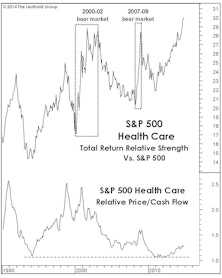
Last month’s tactless comments from MIT health care economist Jonathan Gruber contained an (accidental) investment nugget we’ve alluded to several times in the last three years (and, no, it does not relate to the “stupidity of the American voter” or investor).
What To Do With Broken Models?
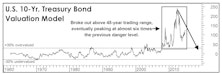
With the quantitative horsepower now available at the fingertips of even the most technophobic portfolio manager, there’s little tolerance for any model that finds itself out of sync. But “broken” models (and especially value-based ones) have an eerie way of reasserting their relevance just after they’ve been finally tossed to the trash heap.
Declining Crude Prices Good For Emerging Markets?

The price of crude oil staged a dramatic change of fate in the past few months, and the bottom is still nowhere in sight.
New Highs = Neutral
We remain positioned with below-average net equity exposure in tactical portfolios for now. We’re inclined to think there may be more trouble ahead for the stock market.
A Game Of ‘What If?’
Considering the Major Trend improvement, new bull market highs (Nov. 6th) on the S&P 500, DJIA, and DJ Transports, we present a list of talking points we’d use if forced to make a bullish stock market case.
What To Make Of Market Leadership
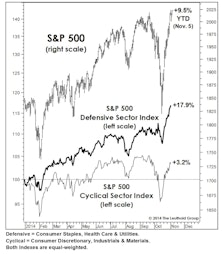
The renewed embrace of risk hasn’t extended to the sector level. After resisting decline in late September through mid-October, defensive sectors have matched the rebound in Cyclicals, almost point for point.
U.S. Versus Foreign Stocks: More Of The Same
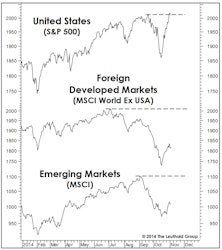
Long before the U.S. dollar began to rebound, the current bull market in global stocks had already favored “provincial” portfolio managers focusing solely on U.S. stocks.
Sentiment: Back To The Brink?

Investors are becoming more and more comfortable buying stock market dips. This is obviously latecycle behavior, but sentiment measures alone aren’t enough to tell us how late.
“Fully-Invested Bears” Are The Year’s Big Winners
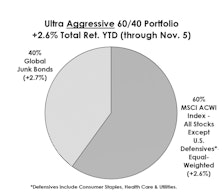
With the S&P 500 at a double digit gain YTD, one would expect those being rewarded are aggressively positioned. We present two hypothetical portfolios and find the hyper-conservative one has nearly doubled the S&P 500 gain.
Economic Green Light?
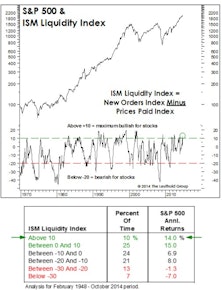
In our quantitative efforts, we typically find it more productive to use the financial markets to forecast the economy rather than the other way around. But there are exceptions...
Inflation & The Dollar

Are U.S. markets for labor and capital actually getting tight?
 Subscribe to Advisor Newsletter