
Inside The Stock Market ...trends, cross-currents, and outlook
Infrastructure Spending & Beneficiaries
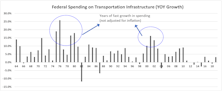
While not yet set in stone, it is the consensus view that infrastructure spending will be raised to a higher level for the next few years compared to past baseline expenditures. Although the exact numbers are still unknown, we examined the President Biden-endorsed bipartisan plan to provide a picture of the relative scale of the anticipated spending in the context of historical trends. In addition, we identified a group of industries that may be beneficiaries of the proposal.
What Should Quants Count?
On May 25th, Fed Chair Jerome Powell promised to pull back emergency support “very gradually over time and with great transparency.”
“Very gradually?” No one doubts that. But “with great transparency?” Not a chance...
Time To Start Thinking About “Thinking About…”
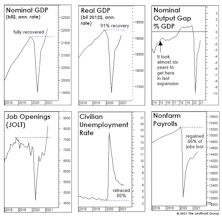
The COVID collapse showed the Fed could abandon its clunky forward guidance and make the appropriate “pivot” when the facts changed. Now that facts have changed for the better, the Fed is right back to the rigid and dogmatic approach that characterized Fed-speak for almost all of the last economic expansion.
We’re The Government And We’re Here To Help

Our trusted civil servants must have found a list of our old Economic/Interest Rates/Inflation components and began to “discontinue” those once invaluable to us and other Fed watchers. It’s a hindrance, but we still have the one that is most correlated to stock prices and it’s free: The ever-expanding balance sheet.
Inflation: Nothing To Fear But The “Lack Of Fear”
The refusal of the bond market to acknowledge the worsening inflation readings seems to have strengthened the consensus view that any inflation trouble will be “transitory.” Do bonds still know best when there’s a systematic, price-insensitive buyer hoovering up $120 billion of them per month?
The Earnings Recession Is History
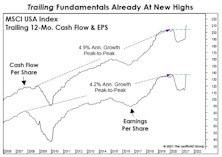
We expected that the earnings recovery from the shortest-ever U.S. recession would be the fastest on record. Trailing figures for the MSCI USA Index now confirm this: Trailing EPS and Cash Flow Per Share have surged to new highs only 14 months after their March 2020 peaks.
Housing: Saner Than You Think
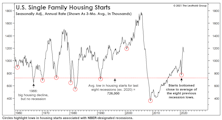
On a technical basis, Homebuilding stocks have only just emerged from their decade-long post-bubble bust. With P/B 24% below the mid-2005 peak and 15% below the “overvalued” threshold, they look reasonably priced in a world that’s almost entirely devoid of value.
Ulterior Fed Motives?

In an echo of last decade, the Fed has come under fire for keeping crisis-based monetary policies in place well after a crisis has subsided. Predictably, the Fed rationalizes its uber-accommodation by citing the slowest-to-recover data series from a set of figures that already suffer from an inherent lag (labor market indicators).
A Small-Cap Theory Of Relativity?
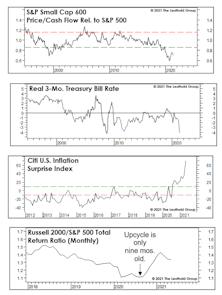
Small Cap median valuations are among the highest in our 40-year database, but they are bottom quintile versus the nose-bleed level of the median Large Cap. If this Small Cap leadership cycle only matches the shortest one on record, it will last another three years. Based on the valuation gap, that guess seems conservative.
The Global EPS Rebound
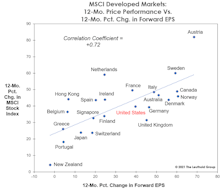
For years, we’ve noted the increasing valuation gap between domestic and foreign stocks. And for years, we contended that the most likely catalyst for a narrowing of that gap would be a recession-induced cyclical bear market in stocks. Evidently the 2020 bear market was not big enough to do the job.
After The SPAC: De-SPAC Performance
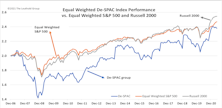
The ultimate measure of a SPAC sponsor’s success is stock performance post merger: De-SPAC results. We analyze historical returns of De-SPACs that had initial market caps greater than $200 million.
Young Bull, Old Threat

By our count, the current bull market is the 13th of the postwar period. The 88% gain achieved by the S&P 500 in less than 14 months already places this bull sixth in terms of cumulative gains. We considered it a hindrance that this bull commenced from higher valuation levels than any other in history. Instead, they seem to have provided a head-start.
Stock Market Observations
The speculative peak for this market rally may have occurred in either January (when GameStop and other “left for dead” short candidates soared), or February (when indexes tracking the “newborns”—IPOs and SPACs—both peaked). But even if we knew that for certain, a major peak in stock prices could still be months away.
Sizing Up The Profit Recovery
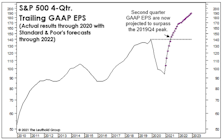
We don’t make much use of “Forward” EPS for the S&P 500 because analyst forecasts have tended to be hopelessly optimistic. But if their short-term projections are on target, when numbers for the current quarter are reported, 12-month trailing GAAP EPS will exceed the $139.47 pre-COVID peak.
New Era Valuations?
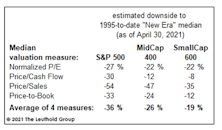
We understand the various rationale for the upward shift in equity valuations seen over the last quarter century or so. Unfortunately, wiping away all market history prior to 1995 does not make stock valuations appear significantly less inflated.
How Much Leverage Is Too Much?
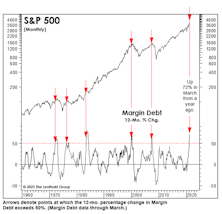
FINRA’s latest report shows a 72% annual gain in margin debt. Yet, in relation to the gain in stock prices, growth in Margin Debt is still well below the peaks of early 2000 and mid-2007—suggesting investors could take on considerably more leverage in the months ahead.
Inflation Watch
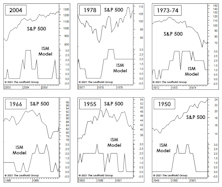
April ISM readings, both for Manufacturing and Services, were hot across the board. That’s good news for a still-recovering Main Street, but it manifested in ways that have frequently caused problems for a famous Street located in Lower Manhattan.
The “Tape” Doesn’t Always “Tell All”
Technicians are collectively bullish because of the absence of any serious internal divergences. But, severe corrections can erupt with little, or no advance warning from a deterioration in breadth and leadership. In fact, the first few years of the last bull market provided two such examples (mid-2010 and mid-2011).
Time For “Timing?”

Valuations aren’t known as effective timing tools, but they can certainly help one decide when an attempt at timing may be appropriate. And if that time isn’t now, then when?
Two More Reasons For Yields To Rise
Bond yields have paused in the last several weeks, but we think it’s likely to be a pause that “refreshes.” Many bond indicators, including the Copper/Gold ratio popularized by Jeffrey Gundlach, suggest yields should be moving dramatically higher in the months ahead.
 Subscribe to Advisor Newsletter