
Macro Monitor
Recession Dashboard Update—Recession Not Imminent

Currently, the dashboard shows 6 green, 3 yellow, and 2 red lights. The overall message is that, while there are areas of concern, a recession is unlikely to be imminent (within the next twelve months).
Risk Aversion Index: Stayed On “Lower-Risk” Signal

With the Fed still on a tightening path, caution is still recommended. Among fixed income, we remain neutral on TIPS but have turned favorable toward EM bonds.
Yield Curve Crossing The 50-Bps Rubicon—No Imminent Trouble

The U.S. 10/2-year curve just fell below the key threshold of 50 bps. Over the last 25 years, the yield curve proceeded to invert after this “Rubicon” was crossed. That doesn’t mean imminent trouble. The lead time of a yield-curve signal is lengthy, but it—and real yields—definitely warrant close monitoring.
Risk Aversion Index: A New “Lower-Risk” Signal

Despite continued weakness in equities and a higher reading in our Risk Aversion Index (RAI), it generated a “Lower-Risk” signal.
Not All “First Hikes” Are Equal

The market has started to price in a much faster pace of the Fed’s tightening this year. We have found more similarities than differences between recent market action and the historical patterns around the first rate hike.
Risk Aversion Index: Stayed On “Higher Risk” Signal

Lofty valuations amid shrinking liquidity conditions make all risky assets vulnerable.
2021 Surprises & 2022 Time Cycles

Market revelations were certainly not in short supply in 2021. We believe some of those surprises will continue to have a huge impact on markets in 2022. We have updated our time-cycle composites to provide an idea of what a “typical” 2022 could look like.
Risk Aversion Index: Stayed On “Higher Risk” Signal

The impact of Omicron is already fading and the global-tightening cycle is far more important going forward. Elevated valuations amid a broadening global-tightening cycle is our key concern.
China—See The Policy Forest Through The Tree (Diagram)

There has been a torrent of new policies coming out of China recently. The goal of this report is to disentangle these seemingly random or even nonsensical policy moves and present a clearer roadmap of what China is thinking and doing.
Risk Aversion Index: New “Higher Risk” Signal

With the market getting less sensitive to each iteration of new variant, we believe the impact of Omicron is unlikely to be as significant as the global-tightening cycle.
Fed Taper—Not A Policy Error
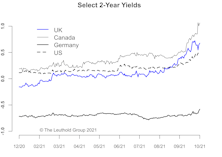
We believe concerns about central-bank policy error are mostly a foreign issue, because they have moved much more aggressively than the Fed. The market has shown no indication of a Fed-policy mistake and we are still on board with the reflation trade.
Risk Aversion Index: New “Lower Risk” Signal

With seasonality once again turning positive and inflation breakeven rates bumping above the recent range, we continue to favor the reflation trade.
“Stagflation” Gap = Limited Impact
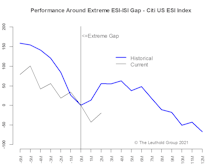
The Citi Economic Surprise Index fell to a negative extreme, while the Citi Inflation Surprise Index made all-time highs—a “stagflation” gap. Overall, if history repeats itself, the extreme ESI-ISI gap is apt to resolve itself, and the effect on asset markets will likely be limited. The global tightening trend will be a far more persuasive driver.
Risk Aversion Index: Stayed On “Higher Risk” Signal

Elevated valuations and a global tightening cycle are usually not a favorable context for risky assets. Within fixed income, we remain positive toward TIPS and cautious on credit.
Rolling In Cash & Spending It In Style

We take a look at how the market rewards different uses for cash and what drives management decisions about the use of cash over time. The focus here is on the three main cash applications: investment (Capex and R&D), return of cash (via buybacks and dividends), and M&A spending.
Risk Aversion Index: Stayed On “Higher Risk” Signal

The reflation trade stayed in a holding pattern with breakeven rates remaining range bound. Within fixed income, we are favorable toward TIPS and cautious on credit.
Not All Inflationary Periods Are Equal
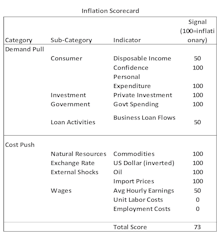
What matters is whether an inflationary period is driven more by “demand pull” or “cost push.” Demand pull inflationary periods seem far more favorable than cost push periods, which, more often than not, occur in a “stagflation” macro context.
Risk Aversion Index: A New “Higher Risk” Signal

Our Risk Aversion Index moved higher and generated a new “Higher Risk” signal. Within fixed income, we are favorable toward TIPS and cautious on credit.
Reflation Trade—Still Has The Benefit Of The Doubt

The Fed surprised the market with a hawkish projection of two rate hikes in 2023. Real yields did not move up as they typically do with such an episode. Overall, the damage was limited to the reflation trade, and the risk-rally is intact.
Risk Aversion Index: Stayed On “Lower Risk” Signal

With the looming Fed taper and valuations stretched on almost all risky assets, volatility is likely to increase in the near term. Among fixed income, we are favorable toward TIPS and cautious on credit.
 Subscribe to Advisor Newsletter