
Inside The Stock Market ...trends, cross-currents, and outlook
Just A Costly Correction?
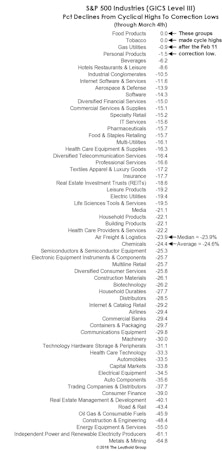
If February 11th marks a lasting low for stocks, the 2015-16 decline will go down as one of the costliest in history not to have reached bear market status.
Implications Of Oversold VLT Momentum

The S&P 500 decline has yet to come close to a bear threshold, but it’s nonetheless been sufficient to drive the Very Long Term (VLT) Momentum algorithm into oversold territory for the first time since late 2009. In 16 of 21 prior cases, VLT Momentum’s initial oversold reading was a harbinger of a market that was soon to become even more oversold.
There’s Always A Hook...
Bear markets need a “hook”—some sort of misdirection that keeps the majority hoping. Our work suggests a primary bear market is underway, and we fear oil is this bear’s hook…but the problems run deeper than oil.
Was That All There Was To It?
As quantitative investors, the disciplines of the numbers trump stories—even our own. But we’re struck that the stories depicted by our Major Trend Index and other market tools over the past two years are entirely logical and sequential. Unfortunately these stories rhyme with those of past market cycles.
Beware The Deceptive S&P…
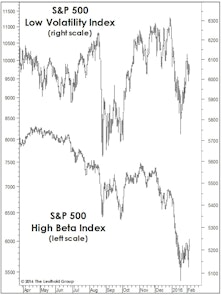
At its January 20th closing low, the S&P 500’s peak-to-trough decline of –12.7% barely met our definition of a severe market correction (an S&P 500 loss of 12% to 18%). But the behavior of this particular index can be quite sinister during the final phase of a bull market—and during much of the ensuing bear.
NYSE “New Lows” Figures Point To “Lower Lows”…
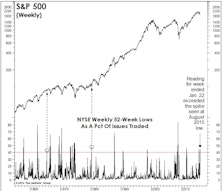
At the August and late January S&P 500 lows, both the Daily and Weekly NYSE New Lows figures exceeded 40% of Issues Traded —a degree of downside thrust rarely seen outside of bear markets.
Learning From Failures?
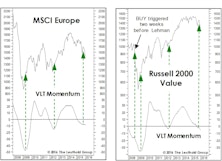
There’s an old trader’s adage which holds that “the most powerful sell signal is a failed buy signal.” Last fall we noted that European equities and Small Cap Value had triggered BUY signals on our Very Long Term (VLT) Momentum algorithm.
Draghi: Losing The Battle And The War
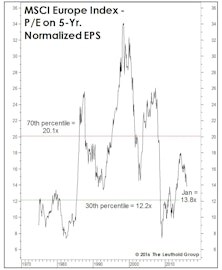
If the current global bear market manages to shake investors’ blind faith in central bankers, this decline might actually accomplish something in the long term. But breaking that faith will take awhile.
Overthinking Market Sentiment

This month’s “Of Special Interest” allots eight pages to the (opposition) view that the correction is over, featuring charts we find the most threatening to our bearish stance. Based on its sudden popularity among the press and punditry, the indicator in this chart—highlighting the air-pocket in investor confidence—perhaps should have been part of that feature. Here’s why it wasn’t.
How Much Slack?

By now it’s consensus that the Fed missed the ideal window for the first rate hike (if one ever existed) by at least a year and a half. We don’t disagree…
Too Early To Dethrone Dividend Stocks?
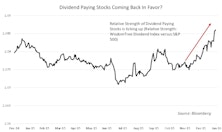
In the context of a low growth/low inflation environment, with the Fed taking its time to guide rates upward, fixed income type of investments may pale by comparison to dividend paying stocks.
Not A “Stealth” Decline Any Longer...
The most compelling evidence that a bear market is underway may not be what’s been punished (Transports, Small Caps), but what hasn’t. We believe the final bull market highs of any composite or sector index were recorded on December 29th.
Two Worrisome Bull Market Highs

Among the dozens of indexes we monitor, the year’s final all-time highs (S&P 500 Consumer Staples and S&P 500 Low Volatility Index on December 29th) can’t possibly provide any comfort to stock market bulls.
Fed Tightening: The Two-Year Anniversary?

We’ve long argued that this tightening cycle began in January 2014, the month of the first of seven tapering moves which occurred through October of that year. There’s both economic and market evidence to back up this claim.
Deciphering The Transports’ Message

The Dow Jones Transports was the first U.S. index to top in this cycle (December 31, 2014), and it closed January 7, 2016 down 24.1% from that historic high. That development, in and of itself, sharply increases the odds that a new cyclical bear market is underway.
The “Star” Is Aligned For 2016
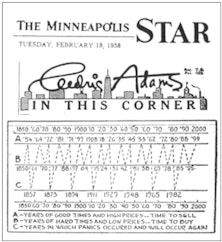
Valuations are high. Market internals are weak. And the MTI is negative. But for those seeking some truly authoritative evidence that there’s stock market danger ahead, consider the accompanying cycle chart unearthed from a gossip column in a 1958 issue of the Minneapolis Star.
Small Cap P/E Ratios: Not Yet Low Enough

When the Fed surreptitiously began to tighten as we believe (via tapering), in January 2014, history suggested that Consumer Discretionary and Small Caps would be the most likely initial market victims (at least from a relative perspective).
Foreign Stocks: The Value Trap Persists
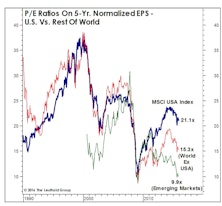
Foreign stocks’ perpetual underperformance has opened up a valuation gap that should look extremely appealing to anyone with a horizon of more than two years. But proceed with caution.
Asset Allocation: No Upside In 2015
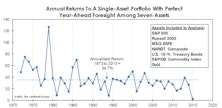
Hedge funds have shuttered by the dozen in the past few weeks, with the worst carnage among those focused on Emerging Markets and commodities. But the problem is broader.
Asset Allocation: Buy Weakness Or Strength?
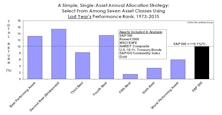
Models can prove helpful in overriding an investor’s natural (and frequently costly) impulses. But we’ve come to believe that our long experience in model building and implementation has succeeded not only in overriding these impulses but in actually modifying them.
 Subscribe to Advisor Newsletter