
This year it’s been popular to say the Fed will hike interest rates until it “breaks something.” Has that not already happened? Pull up charts of the Japanese yen, the British pound, and the euro, among others. And stateside, the Fed has broken one of economists’ favorite toys: the Phillips Curve.
A misconception is that the Phillips Curve predicts an inverse relationship between the unemployment and future inflation rates. (Low unemployment begets higher inflation, and vice versa). But if that were the Phillips Curve, today’s level of inflation would assure us it’s not broken. Instead, A.W. Phillips found strong empirical evidence of an inverse relationship between the unemployment rate and future growth in real wages.
The accompanying chart shows the linkage between the year-end unemployment rate and subsequent one-year growth in real average hourly earnings. As expected, the relationship is inverse, although the moderate correlation coefficient of -0.36 shows there’s plenty of room for real wage growth to fluctuate from the level predicted solely by the unemployment rate. But, year-to-date, that variation has been larger than ever before.
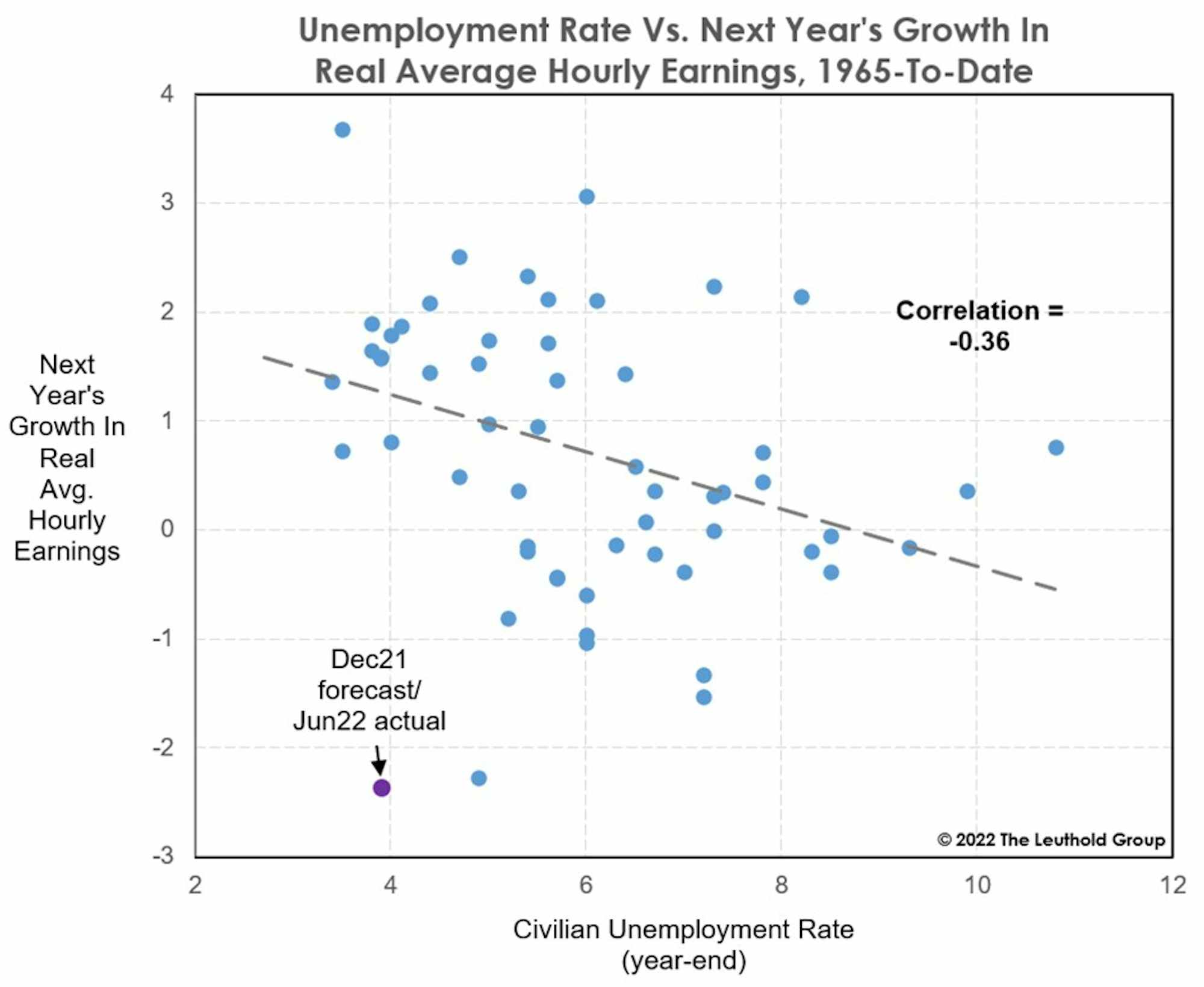
The 2021 year-end unemployment rate of 3.9% would have suggested that real wage growth of a little more than 1% was likely in 2022. However, in the twelve months through June, real wages had declined by a record 2.4%. That reflects growth of 5.2% in average hourly earnings, minus a 7.6% year-over-year increase in the GDP Price Deflator. In real terms, then, workers have been punished like never before at a time when their prospective rewards should have been greatest. No wonder “quiet quitting” is a thing.
There’s still runway available for real wages to improve; our work finds that unemployment levels have a healthy impact on real wage growth out to a three-year horizon. Then again, almost all aspects of the post-COVID period have been compressed in time—meaning that labor’s window to make “real” progress might already be closing.
To cast things in a more positive light, the failure in the Phillips Curve is a reason that corporate profit margins have held firm this year.
And if the Fed can render the Phillips Curve irrelevant, bulls can hope it will do the same to the inverted yield curve.

 Subscribe to Advisor Newsletter